
Let's Focus on the Emerging "AI Trade Deficit"

Mina Azure presents AICU media's "#Society and Ethics of Generative AI" news corner. November 25, 2025. Today, we'll discuss an interesting report on corporate 'strength' in the AI era, published by Andreessen Horowitz (a16z), a prominent US venture capital firm.
The report begins with the article "Moats Before (Gross) Margins: Revisited" posted on May 28, 2020, by David George and Alex Immerman (Moats Before (Gross) Margins: Revisited). This article revisits their theory from five years ago: that a company's value is determined not by immediate profit margins (gross margins) but by defensive walls that protect it from competitors, i.e., 'Moats,' from the perspective of the current proliferation of generative AI.
The authors argue that even in the AI era after the emergence of ChatGPT, the importance of classic 'moats' such as 'network effects,' 'economies of scale,' 'strong brands,' 'high switching costs,' and 'unique technology and data' remains unchanged. Specifically, they cite OpenAI's ChatGPT as an example of establishing a strong 'brand' to the point of becoming synonymous with AI for consumers, and building 'network effects' through memory and collaboration features. Waymo, Flock Safety, and Anduril have built differentiated technologies and IP (intellectual property) that are extremely difficult to replicate.
However, two things have changed in the AI era:
Speed and Momentum: Companies can execute faster than ever before, making 'momentum' more important than ever. 'Momentum' itself is not a 'moat,' but it gives you the right to build one.
The Changing Meaning of Gross Margins: The failure pattern we pointed out earlier is even more dangerous today. High gross margins may indicate that customers are 'not using AI at all' in your product.
Not incurring AI computation costs = potentially not utilizing AI. a16z's report states, "We believe that today’s best businesses are the ones that move quickly to build products that people use and love."
What I particularly focused on here were the points about 'changes' in the AI era. The article states that because companies can execute faster than ever before, 'momentum' itself has become important for gaining the right to build a 'moat.' Furthermore, as an interesting paradox, it points out that high gross margins may rather be a signal that 'AI is not being used in the product.' In other words, because advanced processing with AI incurs costs, companies that provide superior AI experiences even at the expense of profit margins may be the ones that create products that will be loved in the future.
1. Economies of scale
2. Meaningfully differentiated technology
3. Network effects
4. Direct brand power
These four examples are not a definitive list of 'moats,' but they are also healthy points about how startups can build lasting businesses even without high gross margins. We hope this serves as a reminder. Still, the reality is that without high gross margins, achieving a high valuation with meaningful cash flow often requires more than two of these 'moats.'
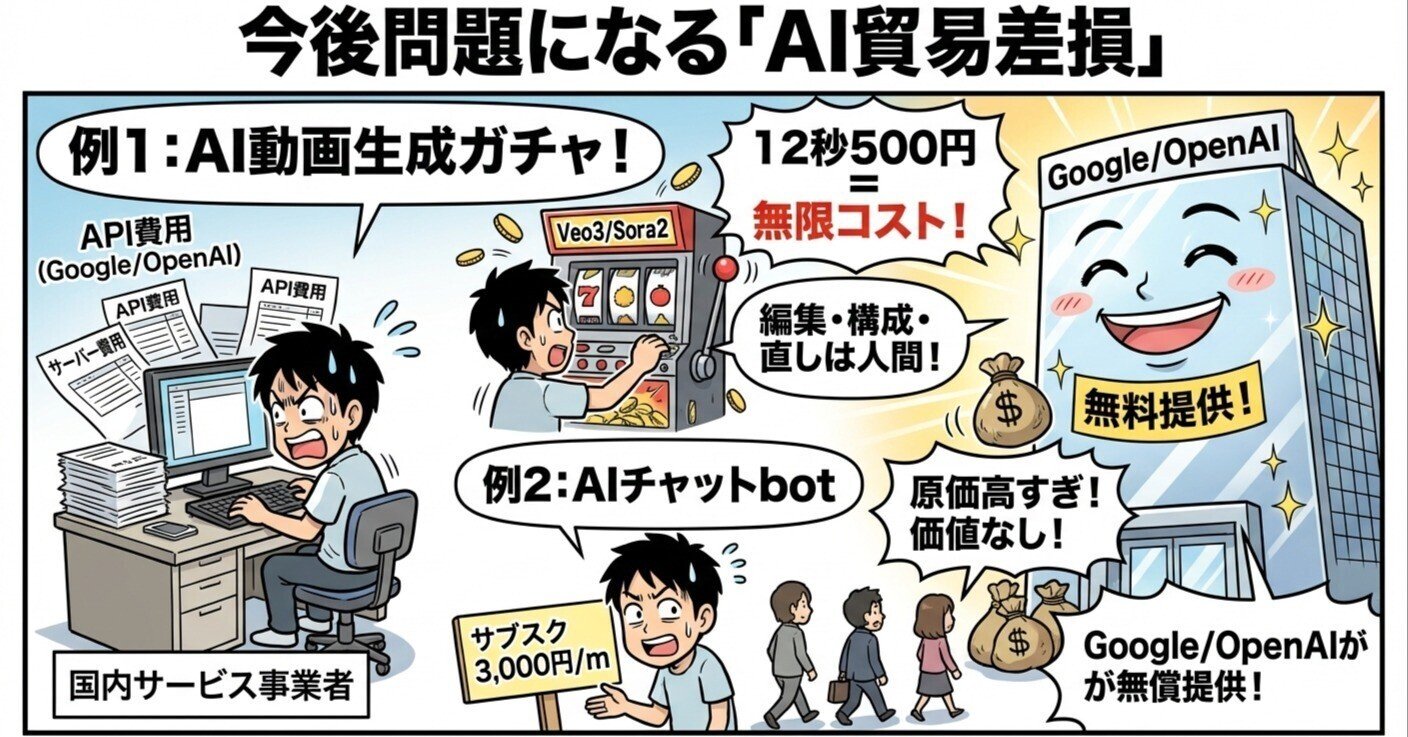
a16z is a US VC that invested approximately 46 billion yen in OpenAI, but from the perspective of Japanese AI creators, the 'wall' creates a new 'AI trade deficit.' a16z's report urged AI companies to 'build 'moats' (strengths that others cannot enter) rather than focusing on immediate profits.' However, the slightly scary reality is emerging that this 'moat' is becoming the very mechanism of 'AI trade deficit' through which wealth continues to flow out for us Japanese users.
Let's consider two specific cases that are happening around us.
Case 1: The Video Creator's "API Gacha" Hell
For example, suppose you receive an order for 1 million yen to produce a 1-minute PR video. At first glance, it's a dreamy amount of money. However, if you use the latest US-made video generation AI such as "Veo3" or "Sora2" for that production, the API usage fee will be approximately 500 yen per 12 seconds. It would be cheap with simple calculation, but generative AI does not produce the desired video in one shot. It's like a so-called 'generation gacha.'
If you repeat regeneration 100 or 200 times until you get the expected quality, the API costs will balloon endlessly. Furthermore, human efforts such as composition, scenario, and editing remain the same as before. As a result, most of the production cost is paid to US AI providers as 'trial and error costs,' leaving only a small profit in the hands of the creators... Such a structure is being created.
Case 2: The Risk of "Sudden Death" for Chatbot Services
Next, suppose a Japanese company develops a convenient AI chatbot service for a monthly fee of 3,000 yen. Even if you pay API costs and server fees for US LLMs (large language models) as cost of goods sold to operate it, one day Google or OpenAI may suddenly change the API specifications, declare the termination of the service, or even release the function as an 'official function' in their own chat service for free. For big tech companies with a16z's "economies of scale" and "network effects," it is easy to swallow surrounding small services. Furthermore, like the termination of the "Nijivoice" service, there is a risk of terminating a newly launched service with thin profits due to a strong sense of ethics or social pressure. As a result, the value accumulated by Japanese developers is instantly reduced to zero, and users are once again drawn to overseas platforms.
US "paid moats," Chinese "free encirclement." What would happen if we in Japan chose the easy path of "AI makes it cheaper!" sandwiched between these? Let's simulate a terrifying scenario of "intense deflationary competition by Japanese domestic companies" as Case 3.
Case 3: The "Scorched Earth Operation" in the Printing, Video, and Design Industries
For example, suppose a production company starts a campaign saying, "Introducing the latest AI 'NanoBanana' and 'Sora2'! 90% OFF design fees!" At first glance, it seems like a dream for consumers, but there is a fatal miscalculation hidden here.
1. Unreduced "Cost of Goods Sold" and "Dialogue Costs"
AI certainly generates images quickly, but it cannot eliminate the time for 'proofreading' and 'correction,' which are the essence of client work. The labor costs for rallies such as 'It's not quite the image I have,' and 'Make this red' will not change as long as humans are responding. Furthermore, fixed costs such as Adobe taxes, electricity bills, and the 'API usage fee (denominated in dollars)' that I mentioned earlier may actually increase by using AI. In other words, while accepting orders saying 'We are making it cheaper by using AI,' they do not actually do any serious manufacturing using AI, and dare to show low-quality results saying 'That's the level of AI,' and may demand additional costs. It may sell at a higher price if AI is demonized.
2. Discounting that accelerates the "AI trade deficit"
If companies lower unit prices for the sake of competition, on-site creators will have no choice but to 'handle more numbers' in order to make a profit. Undertaking a job that used to be 10,000 yen for 1,000 yen using AI. However, if you deduct the payment for overseas tools and electricity bills included in the 1,000 yen, only a few hundred yen will remain... With this, the more we work hard, the more of that sales will flow overseas (the United States and China) as tool usage fees, and we will be in a state like 'AI tenant farmers.'
3. Consumers with a deflationary constitution of "Cheaper is better"
Japanese consumers have a deep sense of 'Cheaper is better' in the 30 years after the collapse of the bubble economy. If coffee is lined up at the supermarket, the person who dares to buy expensive coffee is 'someone who understands the difference.' The feeling that if the function, usability, and taste are the same, cheaper is definitely better has taken root in these 30 years. In addition, in bidding and procurement by government offices and large companies, there is a mechanism that 'the cheaper the better.' Cost reduction is the effort of the company, but what about the world of generative AI creative.
In fact, it is also written in the a16z report that it is a good idea to ask customers face-to-face "Are you willing to pay a higher price than other companies?" If so, it means "You are selling a differentiated product."
The important way to approach this question is to talk to the customer. By having a proper opportunity, the customer may say "No one can match your product now" or "I am willing to pay a higher price." Users may understand that "No one else in the market has the ability to keep building like you." The same is true for corporate procurement. The reason for choosing a particular vendor's product is because it is different from others, and it is unlikely that other companies will be able to hire and retain the personnel to build similar technologies in the coming years. If this is replaced with your work, production, or the field of creative AI, "works will not sell automatically," and it also gives the perspective that "dialogue with customers creates value."
What Happens If You Ignore a16z's "Moats Before Gross Margins"
Remember the teaching from the a16z report at the beginning: "Moats before gross margins." The strategy of "just make it cheaper" is not only a 'moat,' but a 'deflationary quicksand' that destroys its own brand value and exhausts the entire industry. AI should originally be used to spend time on high value-added work that only humans can do. If it is used as an 'excuse to lower unit prices,' the Japanese creative industry will simply become busy and poor without receiving the benefits of technological innovation.
As a law student, I feel that it is necessary to keep a close eye on the deterioration of the working environment of creators and the problems of buying out that are related to the Subcontract Act that such excessive competition will cause. "What kind of new experience can you create using AI" rather than "cheapness." What we should aim for is to exhaust that point.
From the perspective of consumers rather than AI creators, and from an ethical perspective, there are also some points to note here. We must avoid neglecting safety and infringement checks as 'momentum' is emphasized too much. In addition, the point that 'unique data' becomes the company's advantage (moat) is that whether the rights of the creators, who are the source of that data, are properly protected is considered to continue to be a major issue both legally and ethically. I would like to dig deeper from a different perspective on whether the 'moat' that companies build functions as an ecosystem that is beneficial not only to exclusive containment but also to users and society. We will also pay attention to the battle over 'moats,' especially the movements of new forces using the weapon of 'open source.'
The Battle to Break "Moats": From the History of Images to the Present of Videos
As you all know well, in the world of image generation AI, Stability AI etc. broke through the high wall built by OpenAI's "DALL-E" by releasing an open model called "Stable Diffusion." By releasing the technology for free (or in a form close to it), it broke the monopoly of the pioneer and brought 'the freedom to operate on your own PC' to creators around the world. As a result, OpenAI had a moment to return to 'open AI' as its name suggests from secrecy and containment. However, since the above 'moat' and 'wall' strategies are on the VC side, we must be aware that 'containment' will inevitably occur.
And now, the stage has moved to 'video generation,' and new players are trying to play that role. Interestingly, at the center of it are Chinese big tech companies.
Chinese forces breaking down the video generation wall: Tencent and Alibaba
In contrast to US video generation AI, which costs a lot of API costs, models such as Tencent's "HunyuanVideo" and Alibaba's "Wan" are starting to be offered in an open form. These seem to be saviors that technically solve the problem of 'API gacha that costs thousands of yen to create one minute' that we were facing. If you can run it on your own GPU, the cost is only the electricity bill.
"Liberation" or new "containment"
However, as a law student, I can't help but pay attention to the fact that this is not just a charity project. In order to break down the 'moat' that Andreessen Horowitz once spoke of, the model itself is dared to be 'free (commoditized),' cutting off the sources of revenue for OpenAI and Google - this can be said to be a very advanced 'scorched earth operation.'
Furthermore, using these Chinese-made models means that we are becoming familiar with their ecosystem and development environment. While keeping an eye on the containment (lock-in) to the new 'Chinese platform' from the entrance called 'open,' it is necessary to strike a balance.
The Position of Japanese Creators
We Japanese creators are now forced to make the ultimate choice.
Will we continue to pay for high-priced, high-performance, and branded US AI, or will we master Chinese AI, which is inexpensive but has concerns about data transparency? Furthermore, will we build with the open model born in that process and our own computing infrastructure? Is there a risk of relying on another huge system in an attempt to avoid the 'AI trade deficit'? From the gap between technological opening and hegemony, it is necessary not only to 'use it simply because it can be used,' but also to discern where the technology comes from and with what intention it is made public, as well as management including risk management, and furthermore, 'walls and moats' will be required in the production site from now on.
Above, we have delved into "Economics and Ethics in the AI Era" from various perspectives. Regardless of whether you use generative AI tools or not, even if we sweat and do creative activities and development, wealth flows unilaterally overseas as the 'cost of intelligence' that is the foundation for it. This is the identity of the 'AI trade deficit' that is currently feared. a16z says that 'Momentum' is important, but in order not to end up as mere 'paying users,' how do we build our own 'moats,' such as Japanese data, context that AI cannot replace, Japanese commercial distribution, product value, and legal protection? is being questioned.
Above, I have conveyed the economic and ethical issues behind the glamorous AI news.
https://a16z.com/moats-before-gross-margins-revisited/
#Society and Ethics of Generative AI #a16z #AI Business #Ecosystem #AICU #MinaAzure